
Transport Fever 3 Signals and Traffic
Every railway signal is a path signal. A train asks for the track up to the next signal, reversal stop or tram lane on its route, and the signal turns green as soon as that path is free, even if another train is on a different path through the same junction. Most traffic jams come from a train holding a path that crosses someone else's.
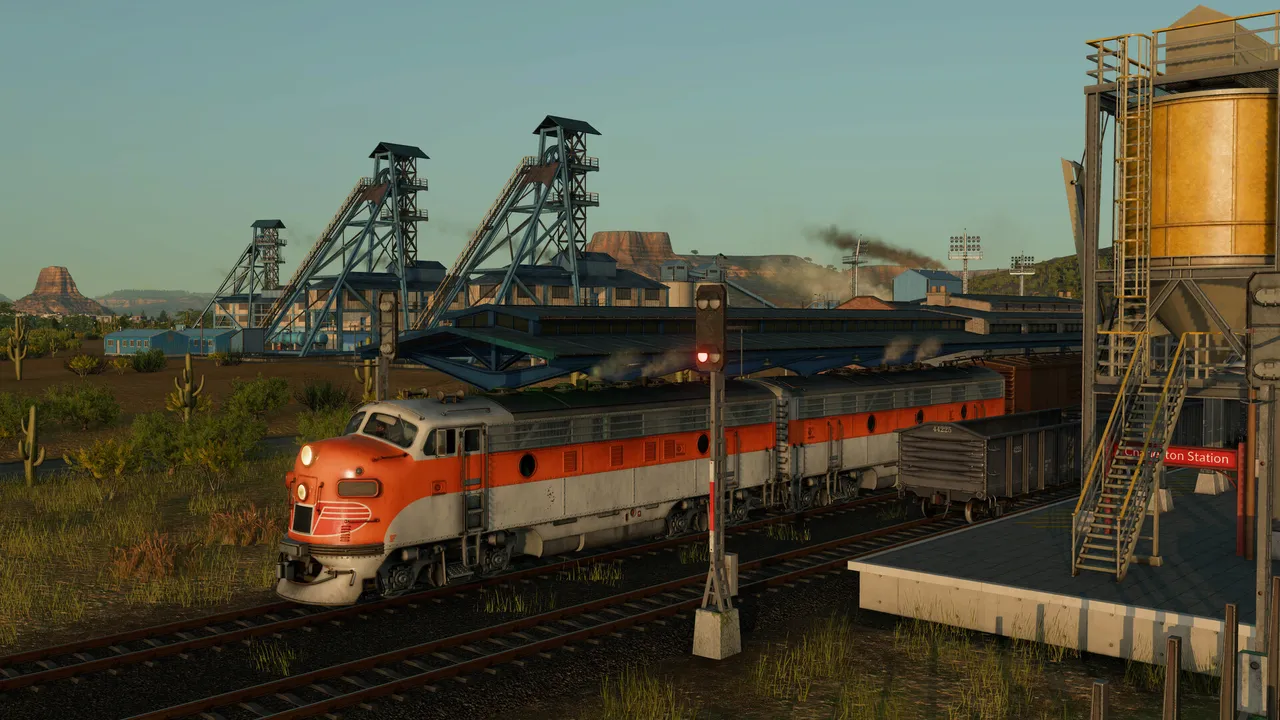
A strict block signal
- Protects a fixed stretch of track
- Two trains entering a station over a crossover: only one may go
- Simple to reason about, wasteful at junctions
A path signal, as in this game
- Protects only the path this train will take
- Two trains over the same crossover on paths that do not overlap: both go
- Needs room after switches so a waiting train does not block another path
Why two trains freeze on a single line
The classic trap is a single line with a passing siding in the middle and no signals in it. Each train, leaving its station, tries to reserve all the way to the far station, because there is no signal or reversal stop in between. Each one's path is blocked by the other, and neither moves. A station on the line does not count as a signal, even if it is a stop on the train's route.
- 1
Put a signal at each end of the siding, on both tracks
Now each train only needs the track to the siding, and the two reservations no longer overlap. - 2
Make the siding signals one-way where it helps
Open a signal's window and set One-way to Yes. One-way signals cannot be passed from behind, which keeps each direction on its own track through the siding. - 3
Leave a full train length after every switch
Place signals far enough past a switch or crossing that the longest train waiting there clears it; otherwise it blocks the other route while it waits. - 4
Add blocks for more trains
Stretch the siding into double track split by several signals, and give the outer stations more platforms, to lift the line's capacity.
Line priority for express trains
By default a train reserves extra track only when it would otherwise have to brake. On shared track that lets a slow regional service slip in front of an express. Raise the express line's priority in the line window and it reserves track further ahead. Reservations now reach to the next signal or the next station where a train can turn back, which also makes passing on single track more workable than in earlier games.
Semaphores before 1950, colour lights after
The game builds semaphore arms on track laid before 1950 and colour-light signals after. They behave the same: a raised arm is green, a horizontal arm is red. Signals that face away from a train are ignored unless they are one-way, so you can force left-hand or right-hand running on double track just by which side the one-way signals stand.
Tram-trains need no signals on the street
Trams marked Light Rail can move between railway track and tram lanes. On the railway part, signal them like trains. Road lanes are one-way and use no reservation, so the street part needs none. The subways page covers the underground tram stations they can serve.
Road traffic is a network problem
Roads are built lane first, with asymmetric roads, irregular junctions, lane connection tools and adjustable phases at traffic lights. None of it fixes a jam on its own: a bottleneck in one place backs traffic up somewhere else. What works is a combination of one-way streets, dedicated bus and tram lanes, waypoints to steer lines off busy streets, and moving heavy cargo off the roads entirely, for example by cargo tram.